
5 Reasons to Teach Kids to Code
Infographic text equivalent
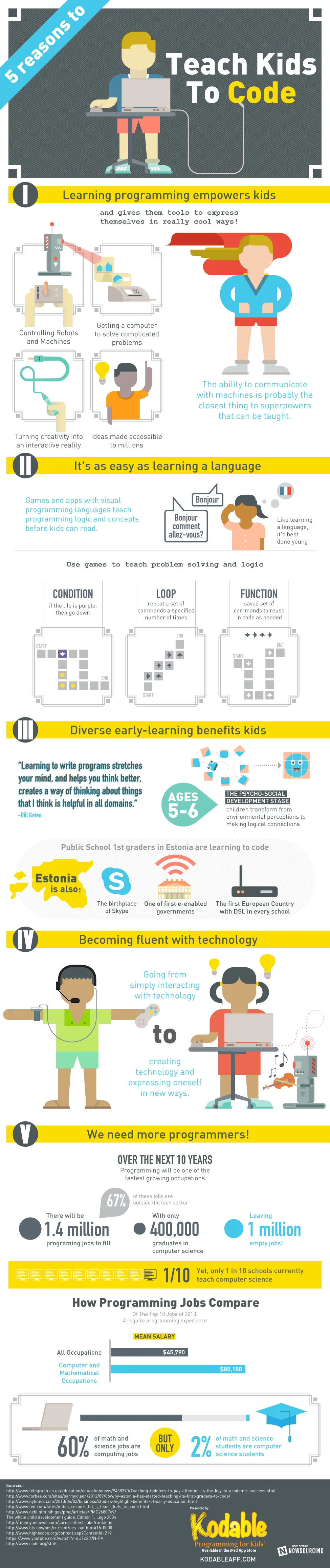
- Learning programming empowers kids and gives them tools to express themselves: controlling robots and machines, getting a computer to solve complicated problems, turning creativity into an interactive reality, and making ideas accessible to millions.
- It’s as easy as learning a language. Games and apps with visual programming languages teach programming logic and concepts before kids can read. Games teach problem solving and logic through conditions, loops, and functions.
- Diverse early learning benefits kids. At ages 5–6, children transform from environmental perceptions to making logical connections. The graphic cites Estonia’s public school first graders learning to code.
- Becoming fluent with technology means going from simply interacting with technology to creating technology and expressing oneself in new ways.
- We need more programmers. The graphic’s historical workforce projections show 1.4 million programming jobs, 400,000 computer science graduates, and one million unfilled jobs over ten years; 67% of jobs outside the technology sector. It states only one in ten schools teaches computer science. Its 2013 salary comparison shows $45,790 for all occupations and $80,180 for computer and mathematical occupations. It compares 60% of math and science jobs being computing jobs with 2% of math and science students studying computer science.
Produced by Kodable and NowSourcing. The statistics and projections are retained historical claims from the original graphic.